
David Porter is the pioneer of “Intelligent Dining”; creating community with Next-Gen Residential and Retail Dining crafted through the lens of SOCIAL ARCHITECTURE™ and Abundance Thinking for campus dining programs.
On October 9, the board of trustees at Gustavus Adolphus College approved a budget that sets a new direction for campus dining. Beginning in fall 2027, the college will replace its a la carte system, where students pay for each item they take, with an all-you-care-to-eat, swipe-based meal plan.
Four days earlier, according to the student newspaper, the student senate had voted unanimously to ask the board to wait. A senate survey drew 690 responses. Sixty-nine percent favored keeping a la carte. Thirteen percent favored the new model. Pricing has not been announced, and three student senators have since been elected to the team that will design the new program.
I have no seat at that table. I have not seen the college’s numbers, and for all I know the design process now under way will win students over completely. This is not about one campus. Many campuses are about to make this same move, and many will hear this same no.
So who is right? What if they both are wrong? This consultant believes the answer lies somewhere in the middle. The students are right about what they want, but wrong that a la carte is the only way to get it. And all you care to eat, the way most campuses have delivered it, is wrong too. First we have to drill down and be honest about what students are really asking for.
What Are They Really Asking For?
Take the vote at face value and it says students want a la carte: a method of payment where you pay for each menu item out of a declining balance. Is that what this is about?
Is there something magically delicious about paying for each item? About managing a declining balance? About worrying in October that you will not have enough to get through the semester, or discovering in December that you have too much left over, might lose it, and need creative ways to burn through it? About a meter that exacerbates their fears of food and nutrition insecurity? Is that what 69 percent of students were voting for?
Are they asking for more disposables and a bigger solid waste stream? I have never met a student who said so.
Or is what they are asking for the experience that a la carte venues happen to deliver? Takeout when they need it. An upscale retail aesthetic. A wide variety of food platforms that are basically the same every meal period of every day, with predictability and consistency. No periods of the day when a significant part of the menu is unavailable. No arriving near the end of a meal period to find the food has run out and is not being replenished.
Look at that second list again. Nothing on it is a method of payment or a method of service. Everything on it is the opposite of what I call the cafeteria operating system, which was state of the art in the 1970s: a limited menu, limited access, limited hours, gaps between meal periods, a constantly changing cycle menu, little or no late night, less on weekends, and food running out before the posted close. Students have learned to associate “all you care to eat” with that 1970s operating system, because on most campuses that is how it is still delivered. They are not defending a declining balance. They are defending the only version of abundance and reliability they have ever been offered.
“You Can Do That?”
Close to thirty years ago, I sat down with a group of students on a campus where they were adamantly opposed to all you care to eat. They wanted all a la carte, and they were not shy about it.
So we did not start with the meal plan. We started by describing the place. What the venue could look like and feel like. A variety of stations for breakfast, lunch, dinner, and late night, Monday through Friday, Saturday, and Sunday. Stations that would not close and change every day. A menu that would not change in every station, every meal period, every day.Display cooking in front of you.
Then I paused and asked the group what they thought. All of the students were 100 percent in.
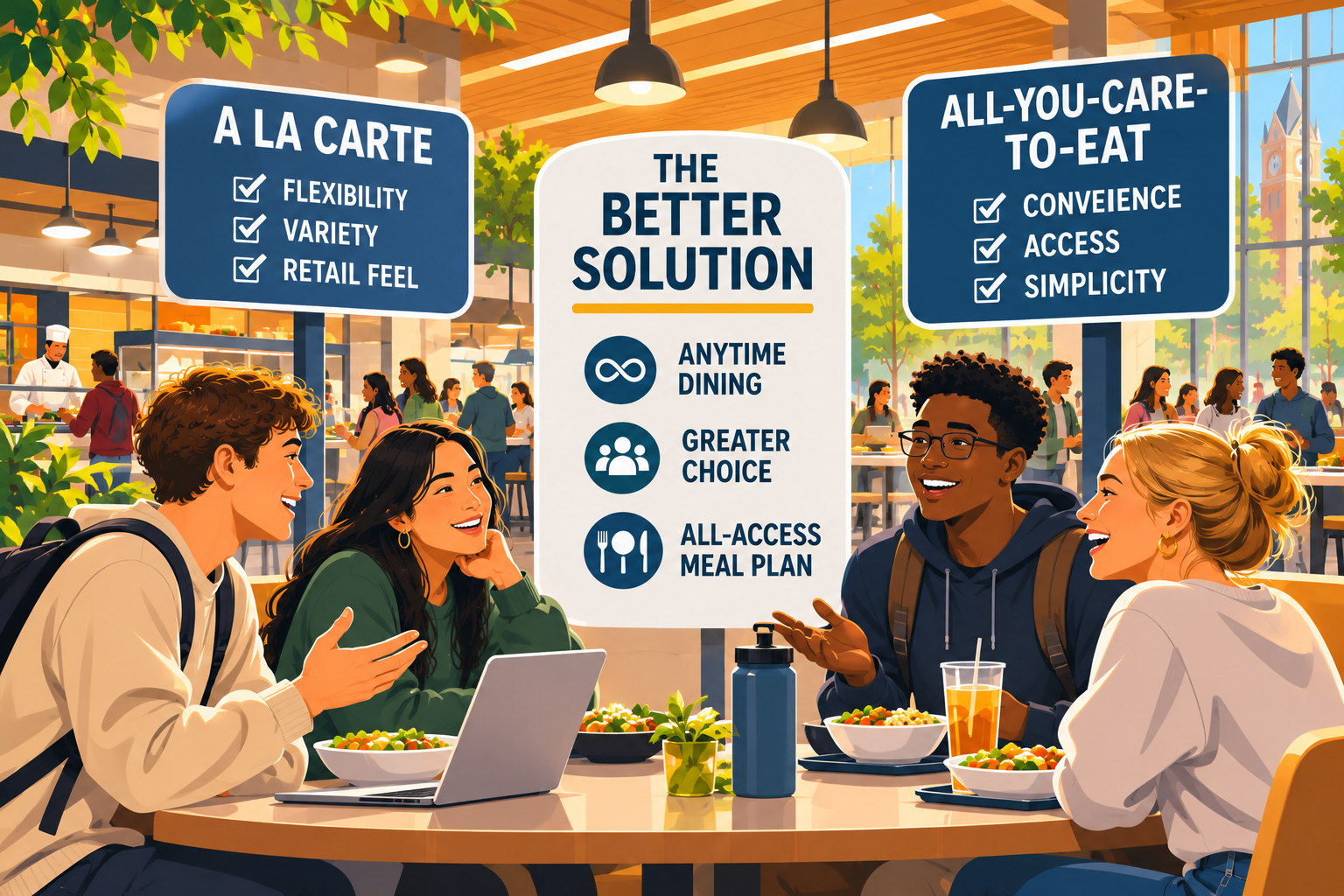
Then I said: think about that program for a second. Now, what if you could go to any of those stations and select your dishes- exactly the same menu items, the same selection- and the only two things that changed were the method of service and the method of payment? In other words, Anytime Dining and an all-access meal plan. You would swipe in at the door, and once you are in, you are in. No point of sale at any station. One checker at the entrance, in case someone without a meal plan wants to pay the door rate.
A few jaws dropped. A few eyes widened. And the chorus was: “You can do that?”
Yes. You can do that.
The Answer in the Middle
That is the middle: Anytime Dining and all-access meal plans. Only the method of service and the method of payment change. The students keep everything they are actually asking for: the retail aesthetic, the variety, the same platforms every day, the food still there at the end of the meal period. The institution gets what all access does better than any other design: no meter, no arithmetic at the station, no student rationing in October, and the student on full aid eating the same dinner at the same table as everyone else. This consultant believes “unlimited” is synonymous with “all access,” and all access is a promise about how much, when, and where. Kept honestly, it evolves a dining transaction into a social transaction, with food playing a supporting role.
Think of it this way. Tying all you care to eat to the 1970s cafeteria is like tying the telephone to a rotary dial or a push-button phone from the same decade. We still have phones today. They are a completely different model, a different technology, and a different value. Anytime Dining is as transformational, and as different from 1970s all you care to eat, as the iPhone 18 Pro Max is from a rotary dial telephone.
That is Intelligent Dining: a program run on what students need rather than on what the production schedule finds convenient. It requires the institution to own the vision and to build it with students, in that order: describe the place first, then the payment. Hours built around the Student Clock. Predictable Abundance until the posted close, weekends included.
And there is a test for whether it worked. Voluntary participation is the purest measure of value. If the residential commons holds roughly 70 percent meal plan participation without equivalencies, swipes, or exchanges in retail propping up the count, the students who voted no have changed their minds with their feet.
Our mini documentary, SOCIAL ARCHITECTURE™: The Missing Ingredient, directed by Emmy Award-winning filmmaker Nick Nanton, was filmed on four campuses across two countries. The voices are first-year students describing what it feels like when a campus engineers belonging instead of leaving it to chance. Watch the mini documentary. Not one of them is checking a balance.
The Question for Your Campus
If your students are telling you they want a la carte, do not argue with them and do not overrule them. Ask them what they love about it. Write the answers down. I will wager that not one answer is “paying for each item.”
Then describe the place before you describe the plan, change only the method of service and the method of payment, and wait for the question. Cafeteria or Intelligent Dining: the swipe at the door is the same in both. What is on the other side of the door is the whole argument. A 69 percent no is not only solvable, it is preventable.
Sources
- “President Moves Forward with Dining Plan Despite Student Senate Resolution,” The Gustavian Weekly, October 16, 2026. https://weekly.blog.gustavus.edu/2026/10/16/president-moves-forward-with-dining-plan-despite-student-senate-resolution/
- David Porter, The Porter Principles, 2nd ed., 2014.
- SOCIAL ARCHITECTURE™: The Missing Ingredient, mini documentary directed by Nick Nanton. https://40059452.hs-sites.com/en/social-architecture%EF%B8%8F-the-missing-ingredient-official-mini-documentary