
David Porter is the pioneer of “Intelligent Dining”; creating community with Next-Gen Residential and Retail Dining crafted through the lens of SOCIAL ARCHITECTURE™ and Abundance Thinking for campus dining programs.
Unlimited is the most generous word in campus dining. It tells a family their son or daughter will never have to check a balance, ration a meal, or go without. Now attach that word to a dining program that keeps limited hours, closes between meal periods, and runs out of food before the posted close. You have sold that family unlimited access to a place their student does not want to be.
Which brings me to a junior at Stony Brook University. “The mandatory [SBU] Premium meal plan for freshmen is stupid,” she told her campus paper.
Her sentence appeared on September 20, in an opinion piece two students published in The Statesman asking whether their meal plans are practical. Freshmen there are required to buy the premium plan. According to the piece, it costs nearly $4,000 a semester and comes with unlimited meal swipes, 500 dining dollars, and a set of meal exchanges.
Read that again. The plan she is calling stupid is the unlimited one.
I have no seat at that table. I have not seen the program, the hours, or the numbers, and the article includes no response from the university. This is not about one campus. Most residential campuses in America have a first-year requirement, and most of them have a student who would say the same thing.
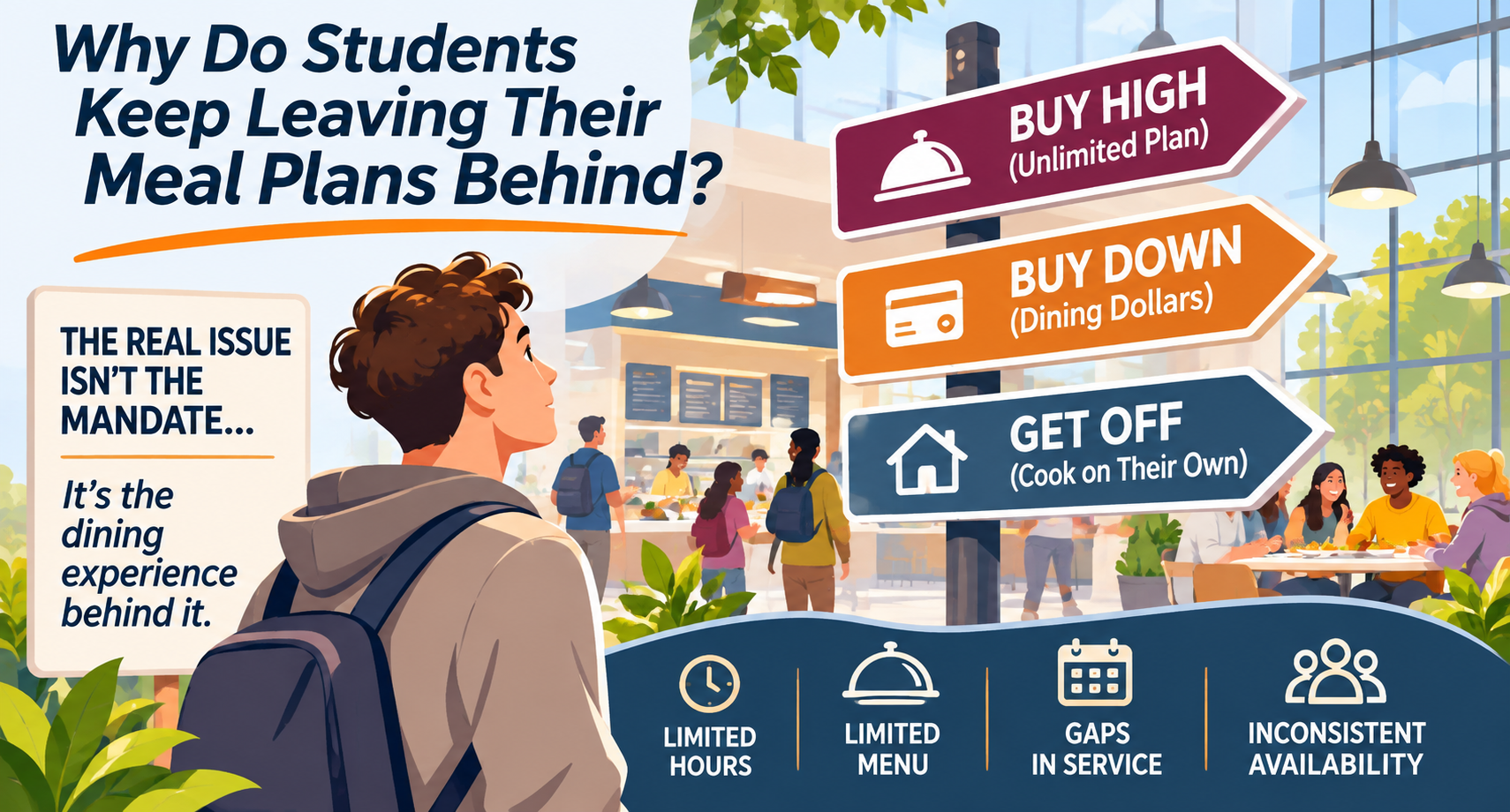
Buy High, Buy Down, Get Off, in One Student’s Three Years
Follow that junior’s own history, as she told it to the paper. As a freshman, she was on the required unlimited plan. As a sophomore, free to choose, she bought down to a plan made up of dining dollars, a declining balance. As a junior, she bought down again, to a small apartment plan, so she could cook for herself.
In The Porter Principles, I called that cycle buy high, buy down, get off. I have rarely seen a student narrate it so cleanly.
Now look at where the buy-down leads. A sophomore in the same article is on that same dining-dollar plan. He told the paper he no longer eats three meals a day, the way he did before college. He budgets his balance to make it last the semester, and he used the word starving to describe it. A senior who commutes said a commuter plan would run out halfway through the term and he would be spending real money after that. The article even includes a chart, shared on social media, of the balance a student should have left each week of the semester.
Think about that chart. Somebody had to publish a rationing schedule for food.
So the authors’ recommendation is to end the mandate and let freshmen choose. I understand why. But the students who already escaped the mandate are in that same article, and what they escaped to is a meter. One of them says he is going hungry on it.
What Did the Mandate Buy?
Here is the part that should stop every administrator. The plan those freshmen are required to buy is called unlimited. On paper, it is the best plan design in campus dining. This consultant believes unlimited is synonymous with all access, and all access is a promise about how much, when, and where. A student on it never has to check a balance or skip a meal in November.
And students are describing it as something to get away from.
That does not happen because of the word mandatory. It happens when the room on the other side of the swipe does not earn the plan. The students in the piece say what they are missing: food they consider healthy, food that is culturally familiar on a very diverse campus, prices that make sense. Across thirty-six years on college and university campuses, I have seen a larger cause underneath complaints like these. I call it the 1970s cafeteria operating system.
The 1970s Cafeteria Operating System, Defined
I do not mean the building. Many campuses have evolved physically into beautiful dining halls and commons. I mean the operating system and business model still running inside them, which was state of the art in the 1970s:
- Limited hours of operation, with gaps between meal periods when the doors are locked or most stations are dark
- A light breakfast and a light lunch
- A limited menu on a constantly changing cycle, so nothing a student counts on is there every day
- Limited or no late night
- Even less on weekends, in both hours and menu offerings
- Food that runs out and is not replenished 30 to 60 minutes before the posted dinner closing
Limited menu, limited access, limited hours. Tying the word unlimited to that system is like tying the telephone to a rotary dial. We still have phones today. They are a completely different model, a different technology, and a different value.
Attach an all-access plan to that system, and unlimited comes to mean unlimited access to a room that is closed, picked over, or not worth the walk.
Parents do not resent buying that plan in August. Most of them want the biggest plan, the one that promises to cover everything, as an expression of love. The resentment arrives later, and it arrives through the student.
One Student Who Uses It Every Day
On November 13, the student paper at Florida A&M asked the same question in a headline: is the meal plan worth the money? More than 4,600 students there are on a plan. The reporter found one student living on campus who said the plan is not worth it. He also found one who said this: “I feel like I use my meal plan every single day.” She feels she gets her money’s worth, because she is not paying out of pocket to eat.
She is the benchmark. Nobody has to require her to do anything.
That is the test for any campus with a mandate. Voluntary participation is the purest measure of value. If your residential dining halls hold roughly 70 percent meal plan participation, with no equivalencies, swipes, or exchanges in retail propping up the count, the mandate is a formality. If they do not, the mandate is the only thing standing between your program and the truth. A mandate fills the count. It does not earn the room.
Do Not End It. Do Not Defend It. Make It Irrelevant.
Ending the requirement sends freshmen to the meter. Defending it tells a student who called it stupid that she is wrong about her own experience. There is a third choice.
Describe the place before you describe the plan. Stations open for breakfast, lunch, dinner, and late night, seven days a week. The same platforms, predictable and consistent, every meal period. Predictable Abundance until the posted close. Hours built around the Student Clock rather than the production schedule. Then attach the plan: Anytime Dining and an all-access meal plan, swipe in at the door, once you are in, you are in. That is Intelligent Dining, and it evolves a dining transaction into a social transaction, with food playing a supporting role.
Our mini documentary, SOCIAL ARCHITECTURE™: The Missing Ingredient, directed by Emmy Award-winning filmmaker Nick Nanton, was filmed on four campuses across two countries. The voices are first-year students describing what it feels like when a campus engineers belonging instead of leaving it to chance. Watch the mini documentary. Not one of them was asked whether the plan was required.
The Question for Your Campus
If you lifted the first-year requirement tomorrow, how many of your freshmen would still buy the plan?
You do not have to lift it to find out. Your sophomores answer the question every spring, when they are free to choose. Count how many buy down, and how many get off.
If you would rather not know the number, you already know it.
Sources
- Katherine Moy and Helen Liu, “Opinions: Are SBU meal plans practical?,” The Statesman, September 20, 2026. https://sbstatesman.com/145336/opinions/opinions-are-sbu-meal-plans-practical/
- Isaiah Clayborn, “Meal swipe mania: Is the FAMU meal plan worth the money?,” The Famuan, November 13, 2026. https://www.thefamuanonline.com/2026/11/13/meal-swipe-mania-is-the-famu-meal-plan-worth-the-money/
- David Porter, The Porter Principles, 2nd ed., 2014.
- SOCIAL ARCHITECTURE™: The Missing Ingredient, mini documentary directed by Nick Nanton. https://40059452.hs-sites.com/en/social-architecture%EF%B8%8F-the-missing-ingredient-official-mini-documentary