
David Porter is the pioneer of creating community with Next-Gen Residential and Retail Dining crafted through the lens of SOCIAL ARCHITECTURE™ and Abundance Thinking for campus dining programs.
This week, auxiliary services leaders from across the country are in Chicago for NACAS C3X, which the association bills as bringing more than 1,000 leaders and business partners under one roof. The opening keynote is titled “Better Together: The Surprising Science and Joy of Social Connection.” Monday afternoon, a panel from Northeastern, Temple, and two national partners presents “Turning Auxiliary Services into Student Success Engines.” Something important is being said out loud. The industry knows social connection is a mission-driven outcome that matters. The auxiliary services portfolio already holds the single most potent day-to-day catalyst on campus for richer student engagement, belonging, retention, academic success, and persistence. And on many campuses it is still programmed like a cafeteria: its hours, its menu, its meal plans, its operating days, and the way it is graded.
“Cafeteria” Is an Operating System, Not a Building
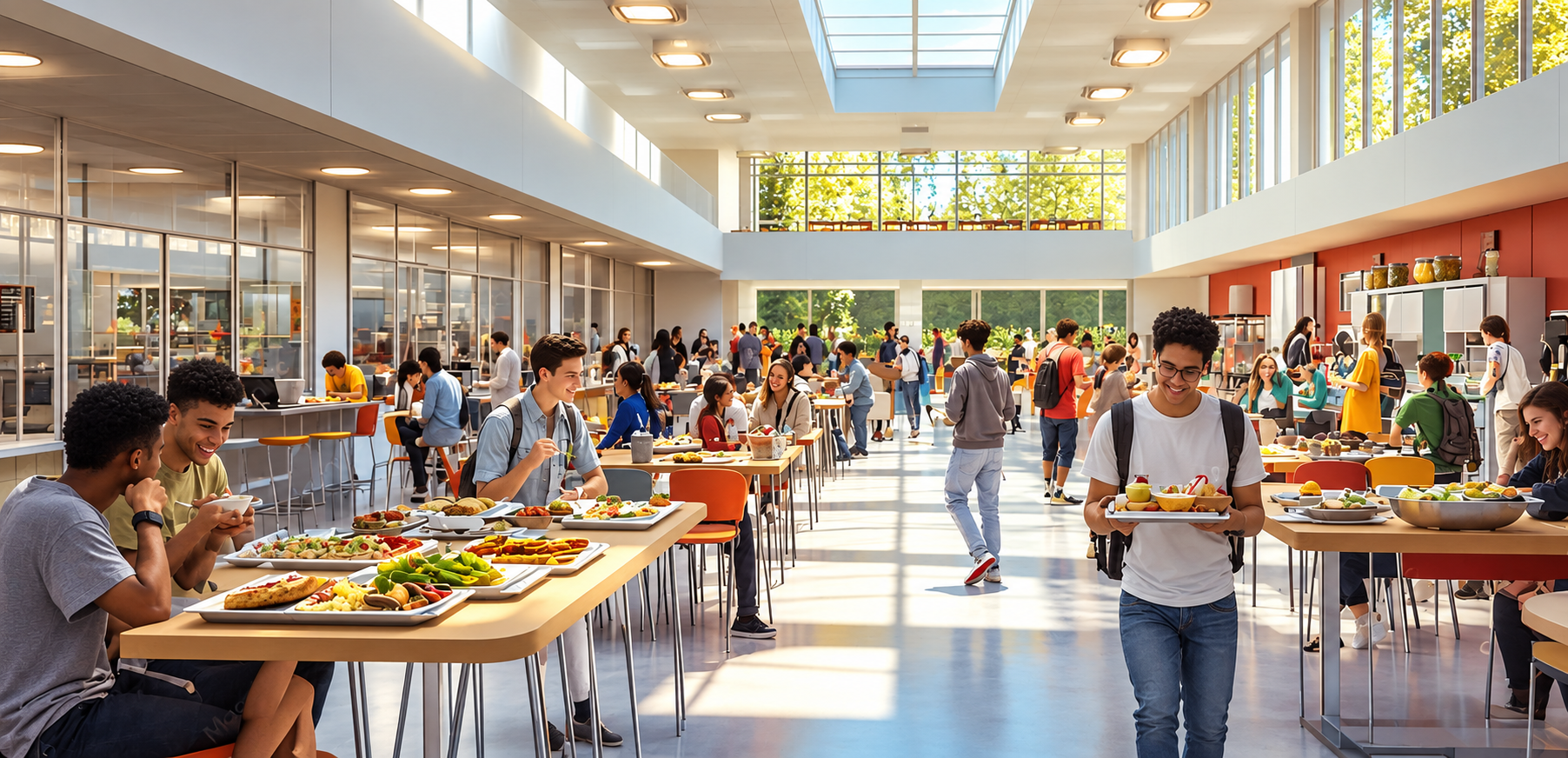
Let me define the word, because many of us have already retired it. Dining halls across the country have evolved physically into dining commons that are, frankly, beautiful: open kitchens, exhibition cooking, daylight, seating that would not look out of place in a five-star hotel and vacation resort. That is not what I mean by cafeteria. I mean the operating system and the business model still being executed inside those beautiful dining rooms and food platforms by the operators running them, often from the same playbook they ran in the old “cafeteria.”
You know it when you see it. Limited hours. Gaps between meal periods, when the doors lock, or when the menu is reduced between breakfast and lunch and between lunch and dinner, and the student who got out of lab at 2:10 pm is greeted by a vending machine or “light lunch.” A cycle menu that changes so often that a student can never count on finding what she came for. Limited or no late night. Even less on weekends, in both hours and offerings, at the exact moments students have the most time to be together. Stations run out of food and are not replenished 30 to 60 minutes before the posted dinner closing time, so the student who arrives at 7:20 for an 8:00 pm close eats whatever is left and learns not to come back at that hour.
None of that is a facilities problem. Every one of those decisions was made by someone, and each one teaches students the same lesson: the dining hall cannot be counted on. A new dining hall can be billed as, and look like, a Social Coliseum on the campus tour and still be operated as a cafeteria every day of the academic year. Students respond to the inside.
Primary to the Mission, Not Adjacent to It
Over the past thirty-six years of interviewing newly minted freshmen, I have asked what they were looking forward to in college back when they were high school seniors. The answer comes back in two words, almost universally: freedom and social.
Here is the claim this consultant will stand behind in front of any president. The friendships, connections, community, emotional security, and freedom from food insecurity a student finds outside the classroom shape the personal and professional arc of that student’s life as much as, if not more than, what happens inside it. The academic side teaches students how to learn. The durable human capacities, the ones that determine whether a student persists through to a degree and who they become after it, are built through the interpersonal skills and friendship networks developed from being immersed in the residential and student life experience and the social ecosystem created and nurtured around a table.
That makes dining primary to the institution’s mission, not a support function adjacent to it. The bookstore sees a student a few times a semester, parking sees the car, and housing sees the student asleep; only dining gathers every student, awake and face to face, two and three times a day for four years. The keynote’s science says social connection drives well-being, engagement, and persistence. The building and program that have the true potential to deliver and enrich those connections daily are the ones most auxiliary leaders are already responsible for.
“Organized Properly” Is the Whole Game
What separates a dining program that is a mission catalyst from one that is a food service line? Not the org chart. Not capital; the room already exists, and the students already walk in with a paid plan. The difference is four decisions.
First, the institution owns the vision, not the operator. Campus leadership creates a granular picture of what a world-class residential and retail dining program is on this campus, by location, method of service, day part, meal plan, and brand portfolio, and then hires a contractor or a self-op team to execute it. Do not abdicate your responsibility to an FSP’s sales team. You may rue the day.
Second, the person running it is a visionary, not a caretaker. A general manager executes a playbook. A Director of Dining designs a campus-wide and residential dining program where joining a table is easy, staying is natural, and sitting alone is a choice, rather than a sentence.
Third, it is measured by the outcome the mission cares about. Voluntary participation is the purest measure of value. If your residential commons achieves roughly 70 percent meal plan participation without equivalencies, swipes, or exchanges propping up the count in retail on or off campus, you have a Social Coliseum. Report that number to the cabinet and the board next to retention and housing occupancy, every term.
Fourth, it runs on Abundance Thinking. Hours are built around the Student Clock rather than the labor schedule. Predictable Abundance, so the good stuff is still there at 8:45 pm, and the stations stay full until the posted close, on weekends too. Table configurations that invite joining, so a freshman eating alone is still inside the hum of the crowd.
The Retention and Persistence Returns the Boards Are Asking For
At NACUBO’s annual meeting in July, the message to chief business officers was that boards no longer accept operations as cost centers; they expect that spending justified as an investment, with a return, in language a trustee can repeat to a parent. Dining, organized properly, is the easiest return in the portfolio to show.
Colleges and universities have long known that when a new student connects socially within roughly the first 45 days, the odds of returning as a sophomore rise sharply. That connection is produced by the same faces at the same tables at the same hours, the last Big Mix, and it happens in the residential dining commons, or it does not happen at all.
Across nearly 500 campuses over more than three decades, many of our clients have reported that student retention increased by 1 to 3 points after their programs were rebuilt through SOCIAL ARCHITECTURE™, often following our rebidding or renegotiation of the food service contract with the incumbent operator. We are subject matter experts, so let us run the numbers for you. Start with one point of retention, multiply it by the net tuition, room, and board you keep for every student who comes back, and add that figure to the line you call remuneration from campus dining. On most campuses, the retention figure dwarfs the remuneration. When trustees ask which operation in the portfolio generates a return, the auxiliary leader who has properly organized dining is the only person in the room who has the answer.
Our mini documentary, SOCIAL ARCHITECTURE™: The Missing Ingredient, directed by Emmy Award-winning filmmaker Nick Nanton, was filmed on four campuses across two countries. The voices are first-year students describing what it feels like when a campus engineers belonging instead of leaving it to chance. Watch the mini documentary. They are describing the science in the keynote, from the inside of the room.
The Question to Bring Home From Chicago
Sunday afternoon, a ballroom full of auxiliary leaders nods at the science of social connection. Monday they walk an expo floor full of lockers, kiosks, and apps designed to make sure students never have to sit down with anyone. The distance between those two rooms is the distance between what the industry knows and how its most potent asset is organized.
So here is the challenge for every auxiliary leader flying home Wednesday. You already own the catalyst. Nobody needs to move it. Put one item on the next cabinet agenda: where, physically, on our campus are friendships supposed to form, and is that room programmed, staffed, and measured as the mission-critical asset it is, or as a cafeteria?
Loneliness, attrition, and the empty bed in the new residence hall are not only solvable, but they are also preventable. The single most potent day-to-day catalyst for engagement, belonging, retention, academic success, and persistence is already in your portfolio. Take ownership and organize it through the lens of SOCIAL ARCHITECTURE™ and Abundance Thinking. Then walk through the dining hall at 10 p.m. on a Sunday night and watch the magic happening. The magic of SOCIAL ARCHITECTURE™.