
How Liberty University’s 3,000-Seat Reber Thomas Dining Commons Redefines Next-Generation Residential Dining in North America
A dining commons is never just a place to eat.
At its best, it is a social ecosystem.
A cultural anchor.
A daily ritual that quietly shapes identity, belonging, and well-being.
At Liberty University, the Reber-Thomas Dining Commons has become exactly that, and more. Today, with seating for more than 3,000 students, it stands as the newest and largest non-military Next-Generation Residential Dining Commons in North America. Yet its significance extends far beyond scale or architecture. The Reber-Thomas story is one of stewardship and conviction, a sustained belief that dining, when thoughtfully conceived and consistently executed, can shape campus culture, strengthen community, and influence the student experience in profound and lasting ways. This is not simply a bigger dining hall.
It is a new day-to-day center of gravity for campus life.
It is the daily heartbeat of the Liberty University campus
Stewardship That Sustains Vision: Louis Cambeletta
Great campus spaces do not happen by accident. They happen because someone chooses to protect an idea long enough for it to mature, scale, and prove itself.
The transformation of Reber Thomas into a 3,000-seat Student Engagement Commons is inseparable from the leadership, commitment, and long view of Louis Cambeletta, Vice President of Auxiliary Services at Liberty University. As the University experienced historic growth, Louis understood that dining could not simply expand operationally. It had to evolve culturally.
From the outset, his responsibilities extended far beyond food service. He embraced dining as a strategic platform for student engagement, retention, and community life. He recognized that the original vision for Reber Thomas was not a project to be completed, but a framework to be stewarded across years of enrollment growth and changing student behavior.
Under Louis’s leadership, the dining program evolved with discipline rather than drift. He resisted short-term fixes and trend-driven solutions in favor of principles that endure. Access over restriction. Choice over control. Hospitality over transaction. As enrollment increased, he ensured that capacity never came at the expense of experience.
The result is not simply the largest residential dining commons in North America. It is one of the most intentional. Reber Thomas functions as a true Student Engagement Commons, a place where students eat, study, gather, linger, and return throughout the day and evening.
Students do not pass through Reber Thomas. They inhabit it. That outcome is the mark of stewardship, not management.
The Strategic Intervention That Changed the Trajectory
Nearly two decades before the opening of today’s Reber Thomas, Liberty University reached a critical inflection point.
When PKC was first engaged, Reber Thomas was a large and dated facility struggling under the weight of growth. Long lines, congestion, and recurring production shortfalls dominated the student experience. Despite its size, the building could not perform. Student dissatisfaction was rising, and confidence was eroding.
Conventional wisdom was clear. Reber Thomas was viewed as the problem.
The prevailing recommendation was demolition and replacement with a large, consumption-driven retail-style food court. At the time, this thinking aligned with industry norms and enjoyed broad support.
The PKC strategic planning process led to a very different conclusion.
Through market research, campus immersion, and disciplined analysis of student behavior, it became clear that the issue was not the building itself, but how it had been programmed and operated. Viewed through the lens of SOCIAL ARCHITECTURE™ and Abundance Thinking, Reber Thomas revealed untapped potential.
The strategy shifted away from scarcity and transaction toward access and choice. The Anytime Dining program redefined how and when students engaged with dining. Simultaneously, the facility was reconceived as a Dining Learning Commons designed to relieve congestion, improve throughput, and foster community.
When the transformed Reber Thomas reopened, the impact was immediate and measurable. Student satisfaction surged. Operational pressure eased. The facility became a destination rather than an obstacle.
That intervention established the principles Louis Cambeletta would later steward, scale, and bring to full expression in today’s Student Engagement Commons.
From Program to Place
As Liberty University continued to grow, the expectations placed on its dining program evolved. What had once been a programmatic shift eventually required a physical expression that matched its cultural importance.
The new Reber Thomas Dining Commons is that expression.
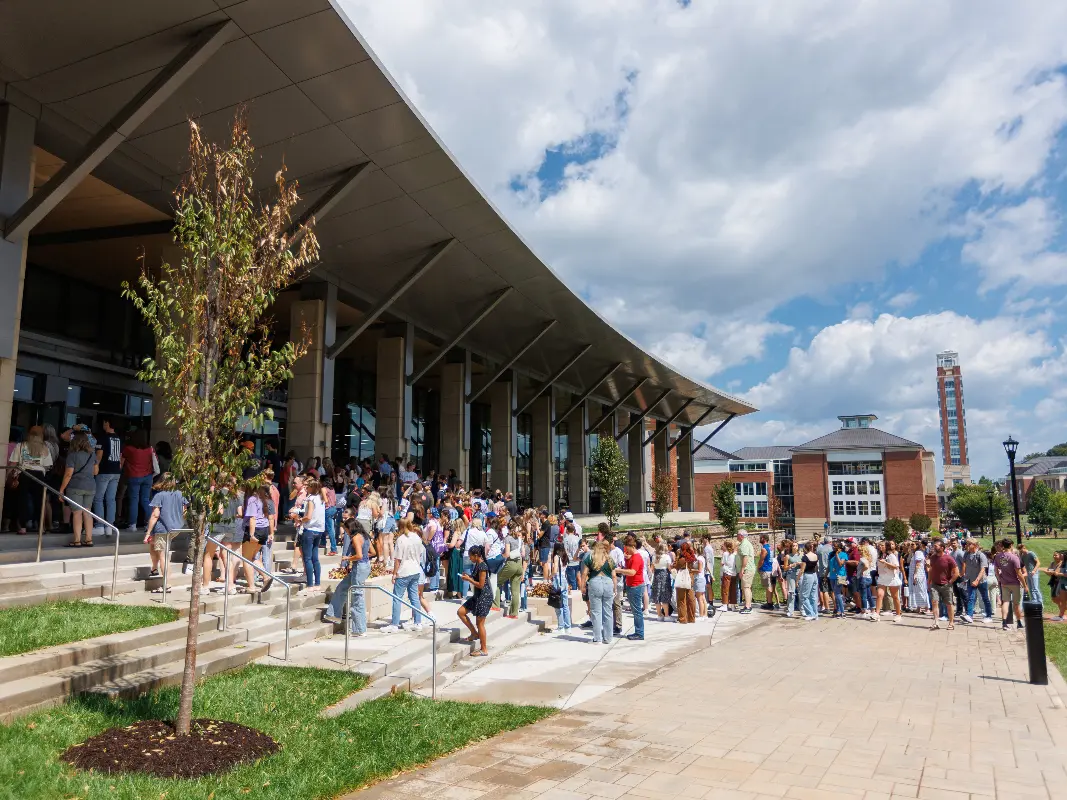
At more than 120,000 square feet, with seating for over 3,000 students indoors and out, the facility is intentionally scaled yet deeply human. It does not feel institutional. It feels inhabited. Natural light fills the space. Sightlines encourage movement and discovery. Seating ranges from large communal tables to quieter settings that support study, conversation, and time.
With more than two dozen distinct culinary platforms, students experience genuine choice without fragmentation. The environment is not linear or transactional. It is exploratory, relational, and inclusive.
This is SOCIAL ARCHITECTURE™ made visible. Design that shapes behavior without dictating it.
Abundance as an Operating System
At this scale, efficiency alone would have been the easy objective. But efficiency without empathy produces emptiness.
Instead, Reber Thomas operates on the basis of Abundance Thinking. Continuous service relieves pressure on peak periods. Extended hours respect the student clock. Multiple platforms distribute demand organically rather than through enforcement.
Central to this approach is predictability.
Students do not experience consistency as boredom. They experience it as a sense of security and confidence.
Reber Thomas is intentionally anchored by core platforms available every day. A consistent grill program provides made-to-order proteins and familiar accompaniments. A daily pizza platform serves as both a comfort anchor and a high-volume stabilizer. Homestyle and comfort offerings deliver recognizable flavors that ground the experience. Fresh salad and produce-driven platforms emphasize balance and customization rather than restriction.
Alongside these anchors, globally inspired platforms introduce international and regional cuisines within a predictable framework. Bakery and dessert offerings are part of the daily rhythm rather than special events. Beverage and hydration stations are distributed throughout the space to support flow and reduce congestion.
Allergen-aware and gluten-free offerings are fully integrated into the daily program. Students with dietary restrictions have continuous access to safe, thoughtfully prepared meals while remaining part of the shared dining experience.
The result is confidence.
Students do not enter Reber Thomas wondering whether they will find something to eat. They enter knowing they will.
Predictability reduces decision fatigue. It lowers anxiety. It encourages habitual use.
And habit matters more than novelty.
Dining Frequency, Belonging, and Student Retention
During my recent on-campus visit with Louis Cambeletta, the conversation moved beyond design and operations to something more consequential.
Data became the focus.
Louis shared that his team has been deliberately analyzing dining behavior over time, focusing not just on participation but also on frequency. What emerged from that analysis was both clear and compelling. Students who eat more meals per week in Reber Thomas demonstrate higher retention and persistence than those who eat fewer meals.
This insight was not presented as a marketing claim. It was the result of a disciplined review that aligned dining usage patterns with enrollment outcomes and asked a simple question. Where do students who stay spend their time?
Consistently, the answer led back to Reber Thomas.
Students who dine more frequently in the residential dining commons are more connected to campus rhythms. They are more likely to form routines. More likely to encounter peers. More likely to anchor their day around shared experiences rather than isolated transactions. Over time, those patterns translate into persistence.
Louis was clear that this relationship is not accidental. Dining frequency is not simply about food. It is about belonging.
Reber Thomas was intentionally designed to encourage that frequency. Continuous access removes barriers. Predictable platforms reduce friction. Consistent availability lowers the threshold for participation. Students do not have to plan around dining. Dining becomes part of their day.
From a SOCIAL ARCHITECTURE™ perspective, this is exactly the point. Retention does not occur only in classrooms or advising offices. It occurs in the spaces where students feel known, welcomed, and part of something larger than themselves.
Reber Thomas does not just feed students. It quietly increases the likelihood that they stay.
More Than a Dining Hall
Reber Thomas is no longer simply a place where students eat. It is where friendships form, study groups gather, and daily rhythms take shape. It is where students feel welcomed, grounded, and connected.
It is a reminder that when dining is intentionally designed, strategically guided, and carefully stewarded, it becomes one of the most powerful forces on campus.
The building may be new.
The vision is not.
And that may be its greatest achievement.