Design Without Operational Insight Creates Beautiful Dysfunction


Higher education has no shortage of beautifully designed dining facilities.

They win awards. They photograph well. They appear in viewbooks and on websites as evidence of institutional investment.

And yet, many of these spaces struggle from the day they open.

Lines spill into corridors. Seating looks abundant but feels scarce. Kitchens strain under menus they were never designed to support. Staff work heroically around layouts that resist them. Students quietly vote with their feet.

This is what happens when design is separated from operational insight.

The result is beautiful dysfunction.

When Aesthetics Lead and Systems Follow

Architecture often leads dining conversations because dining spaces are emotional spaces. They shape first impressions, influence recruitment, and signal institutional priorities.

But dining is not static. It is a living system that must function predictably every day. When form is prioritized without understanding how food is produced, served, accessed, and experienced hour by hour, the building itself becomes the constraint.

This is not a failure of creativity. It is a failure of integration.

SOCIAL ARCHITECTURE™ Is About Access, Not Just Atmosphere

SOCIAL ARCHITECTURE™ is not about making spaces look social. It is about designing environments that invite participation, reduce friction, and foster belonging.

Belonging begins with access.

Students must be able to enter easily, navigate intuitively, and feel welcome immediately. Dining environments should meet students where they are, socially, culturally, and economically. When access is restricted, confusing, or inconsistent, community breaks down.

Operational insight ensures that:

  • Entry points are open and intuitive
  • Circulation is predictable and calm
  • Hours of operation align with real student lives
  • Spaces feel inclusive rather than intimidating

Architecture alone cannot deliver this. Operations bring it to life.

Abundance Thinking Creates Predictability and Trust

Abundance Thinking is not about excess. It is about confidence.

Students value choice, but they value predictability even more. Knowing what will be available, when it will be available, and that it will be done well builds trust.

Predictable and consistent menu offerings are a cornerstone of abundance. They reduce decision fatigue. They create comfort. They allow students to build routines in an otherwise unpredictable academic world.

Abundance Thinking asks:

  • How do we offer enough variety without confusion
  • How do we maintain consistency without becoming stale
  • How do we ensure quality every day, not just on showcase occasions

Design without operational insight cannot support this balance.

Authentic Cuisine Requires Operational Alignment

Authenticity cannot be staged.

Students recognize the difference between cuisine that is performative and cuisine that is real. Authentic food requires appropriate equipment, proper prep space, skilled staff, and menus that respect culinary traditions rather than dilute them for convenience.

When kitchens are not designed to support authentic cuisine, institutions are forced to compromise. Menus become simplified. Flavors are flattened. Concepts lose credibility.

Authenticity is an operational commitment expressed through design.

Customer Service Is Spatially Enabled

Great customer service does not happen by accident. It is shaped by environment.

Staff who are rushed, hidden, or constrained by poor layout cannot deliver warmth, consistency, or care. Conversely, spaces that support visibility, flow, and dignity allow staff to engage rather than react.

SOCIAL ARCHITECTURE™ recognizes staff as central to the student experience. When staff are supported operationally, service improves naturally. Respect becomes visible.

Students feel it immediately.

Unrestricted Access Changes Behavior

Restrictive access models signal scarcity.

Limited hours, confusing meal plans, and closed venues communicate that dining is transactional rather than communal. Students respond by minimizing engagement.

Abundance Thinking promotes unrestricted access. Broad hours. Clear value. Freedom to enter, eat, linger, and return.

Unrestricted access transforms dining from an obligation into a destination. It encourages spontaneous connection and repeated use. It allows dining to function as a true social ecosystem.

Value Is More Than Price

Students are acutely aware of value.

An unrivaled value proposition is not about being the cheapest. It is about delivering quality, consistency, access, and experience in a way that feels fair and generous.

When students perceive value, satisfaction rises. When they do not, no amount of architectural beauty can compensate.

Design and operations together must support:

  • Consistent quality
  • Reliable availability
  • Authentic food
  • Genuine service
  • Freedom of use

This is abundance in action.

Beautiful Dysfunction Is Predictable

The symptoms of beautiful dysfunction are familiar:

  • Congestion during peak periods
  • Staff burnout
  • Menu compromise
  • Underutilized space
  • Student disengagement

These are not operational failures. They are planning failures.

Once embedded in architecture, they persist for decades.

Integration Transforms Dining

When operational insight leads alongside design, dining becomes more than a facility. It becomes a platform.

A social ecosystem built on access.
Predictability.
Authenticity.
Service.
Freedom.
Value.

This is SOCIAL ARCHITECTURE™ grounded in Abundance Thinking.

The Real Measure

The measure of success is not how a dining facility looks on opening day.

It is how it works on a rainy Tuesday night during midterms.

Does it feel open
Does it feel dependable
Does it feel welcoming
Does it feel worth it

When the answer is yes, dining becomes a place students choose, not endure.

Design without operational insight creates beautiful dysfunction.

But when design, operations, SOCIAL ARCHITECTURE™, and Abundance Thinking are fully aligned, dining becomes something far more powerful.

A place to eat.
A place to belong.
A place where campus life truly happens.
The New Day-to-Day Center of Gravity and Heartbeat of the Campus

How Liberty University’s 3,000-Seat Reber Thomas Dining Commons Redefines Next-Generation Residential Dining in North America

A dining commons is never just a place to eat.

At its best, it is a social ecosystem.
A cultural anchor.
A daily ritual that quietly shapes identity, belonging, and well-being.

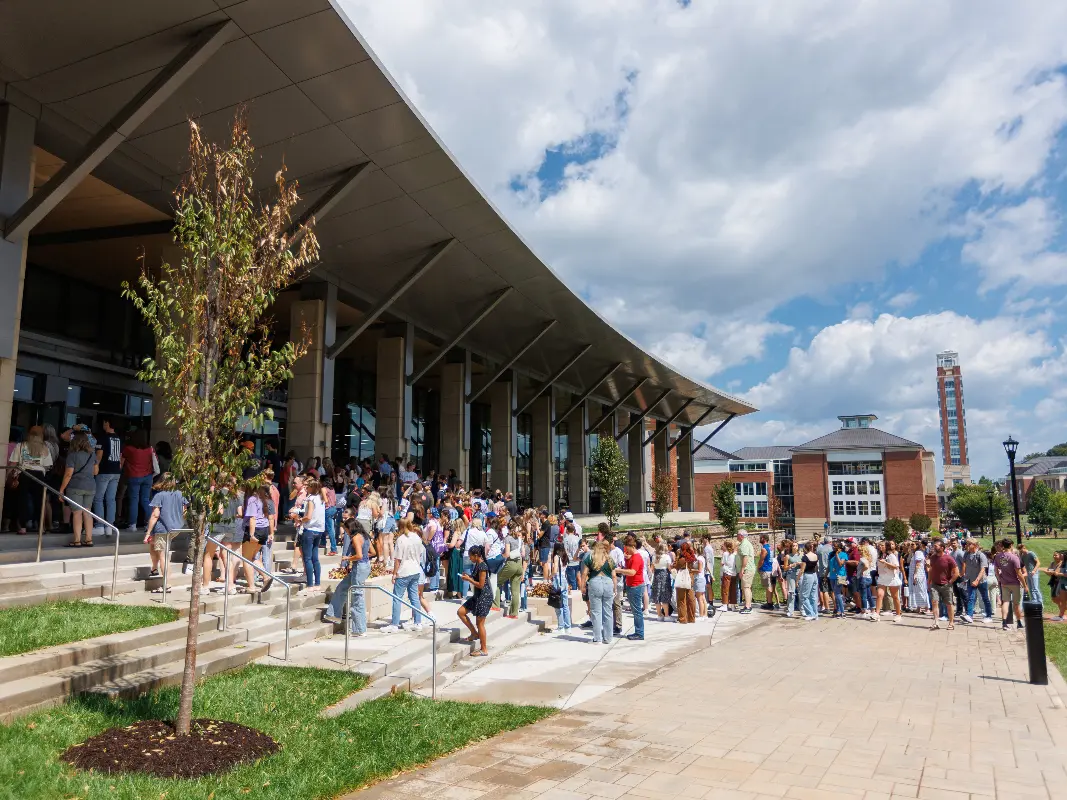
At Liberty University, the Reber-Thomas Dining Commons has become exactly that, and more. Today, with seating for more than 3,000 students, it stands as the newest and largest non-military Next-Generation Residential Dining Commons in North America. Yet its significance extends far beyond scale or architecture. The Reber-Thomas story is one of stewardship and conviction, a sustained belief that dining, when thoughtfully conceived and consistently executed, can shape campus culture, strengthen community, and influence the student experience in profound and lasting ways. This is not simply a bigger dining hall.

It is a new day-to-day center of gravity for campus life.
It is the daily heartbeat of the Liberty University campus

Stewardship That Sustains Vision: Louis Cambeletta

Great campus spaces do not happen by accident. They happen because someone chooses to protect an idea long enough for it to mature, scale, and prove itself.

The transformation of Reber Thomas into a 3,000-seat Student Engagement Commons is inseparable from the leadership, commitment, and long view of Louis Cambeletta, Vice President of Auxiliary Services at Liberty University. As the University experienced historic growth, Louis understood that dining could not simply expand operationally. It had to evolve culturally.

From the outset, his responsibilities extended far beyond food service. He embraced dining as a strategic platform for student engagement, retention, and community life. He recognized that the original vision for Reber Thomas was not a project to be completed, but a framework to be stewarded across years of enrollment growth and changing student behavior.

Under Louis’s leadership, the dining program evolved with discipline rather than drift. He resisted short-term fixes and trend-driven solutions in favor of principles that endure. Access over restriction. Choice over control. Hospitality over transaction. As enrollment increased, he ensured that capacity never came at the expense of experience.

The result is not simply the largest residential dining commons in North America. It is one of the most intentional. Reber Thomas functions as a true Student Engagement Commons, a place where students eat, study, gather, linger, and return throughout the day and evening.

Students do not pass through Reber Thomas. They inhabit it. That outcome is the mark of stewardship, not management.

The Strategic Intervention That Changed the Trajectory

Nearly two decades before the opening of today’s Reber Thomas, Liberty University reached a critical inflection point.

When PKC was first engaged, Reber Thomas was a large and dated facility struggling under the weight of growth. Long lines, congestion, and recurring production shortfalls dominated the student experience. Despite its size, the building could not perform. Student dissatisfaction was rising, and confidence was eroding.

Conventional wisdom was clear. Reber Thomas was viewed as the problem.

The prevailing recommendation was demolition and replacement with a large, consumption-driven retail-style food court.  At the time, this thinking aligned with industry norms and enjoyed broad support.

The PKC strategic planning process led to a very different conclusion.

Through market research, campus immersion, and disciplined analysis of student behavior, it became clear that the issue was not the building itself, but how it had been programmed and operated. Viewed through the lens of SOCIAL ARCHITECTURE™ and Abundance Thinking, Reber Thomas revealed untapped potential.

The strategy shifted away from scarcity and transaction toward access and choice. The Anytime Dining program redefined how and when students engaged with dining. Simultaneously, the facility was reconceived as a Dining Learning Commons designed to relieve congestion, improve throughput, and foster community.

When the transformed Reber Thomas reopened, the impact was immediate and measurable. Student satisfaction surged. Operational pressure eased. The facility became a destination rather than an obstacle.

That intervention established the principles Louis Cambeletta would later steward, scale, and bring to full expression in today’s Student Engagement Commons.

From Program to Place

As Liberty University continued to grow, the expectations placed on its dining program evolved. What had once been a programmatic shift eventually required a physical expression that matched its cultural importance.

The new Reber Thomas Dining Commons is that expression.

At more than 120,000 square feet, with seating for over 3,000 students indoors and out, the facility is intentionally scaled yet deeply human. It does not feel institutional. It feels inhabited. Natural light fills the space. Sightlines encourage movement and discovery. Seating ranges from large communal tables to quieter settings that support study, conversation, and time.

With more than two dozen distinct culinary platforms, students experience genuine choice without fragmentation. The environment is not linear or transactional. It is exploratory, relational, and inclusive.

This is SOCIAL ARCHITECTURE™ made visible. Design that shapes behavior without dictating it.

Abundance as an Operating System

At this scale, efficiency alone would have been the easy objective. But efficiency without empathy produces emptiness.

Instead, Reber Thomas operates on the basis of Abundance Thinking. Continuous service relieves pressure on peak periods. Extended hours respect the student clock. Multiple platforms distribute demand organically rather than through enforcement.

Central to this approach is predictability.

Students do not experience consistency as boredom. They experience it as a sense of security and confidence.

Reber Thomas is intentionally anchored by core platforms available every day. A consistent grill program provides made-to-order proteins and familiar accompaniments. A daily pizza platform serves as both a comfort anchor and a high-volume stabilizer. Homestyle and comfort offerings deliver recognizable flavors that ground the experience. Fresh salad and produce-driven platforms emphasize balance and customization rather than restriction.

Alongside these anchors, globally inspired platforms introduce international and regional cuisines within a predictable framework. Bakery and dessert offerings are part of the daily rhythm rather than special events. Beverage and hydration stations are distributed throughout the space to support flow and reduce congestion.

Allergen-aware and gluten-free offerings are fully integrated into the daily program. Students with dietary restrictions have continuous access to safe, thoughtfully prepared meals while remaining part of the shared dining experience.

The result is confidence.

Students do not enter Reber Thomas wondering whether they will find something to eat. They enter knowing they will.

Predictability reduces decision fatigue. It lowers anxiety. It encourages habitual use.

And habit matters more than novelty.

Dining Frequency, Belonging, and Student Retention

During my recent on-campus visit with Louis Cambeletta, the conversation moved beyond design and operations to something more consequential.

Data became the focus.

Louis shared that his team has been deliberately analyzing dining behavior over time, focusing not just on participation but also on frequency. What emerged from that analysis was both clear and compelling. Students who eat more meals per week in Reber Thomas demonstrate higher retention and persistence than those who eat fewer meals.

This insight was not presented as a marketing claim. It was the result of a disciplined review that aligned dining usage patterns with enrollment outcomes and asked a simple question. Where do students who stay spend their time?

Consistently, the answer led back to Reber Thomas.

Students who dine more frequently in the residential dining commons are more connected to campus rhythms. They are more likely to form routines. More likely to encounter peers. More likely to anchor their day around shared experiences rather than isolated transactions. Over time, those patterns translate into persistence.

Louis was clear that this relationship is not accidental. Dining frequency is not simply about food. It is about belonging.

Reber Thomas was intentionally designed to encourage that frequency. Continuous access removes barriers. Predictable platforms reduce friction. Consistent availability lowers the threshold for participation. Students do not have to plan around dining. Dining becomes part of their day.

From a SOCIAL ARCHITECTURE™ perspective, this is exactly the point. Retention does not occur only in classrooms or advising offices. It occurs in the spaces where students feel known, welcomed, and part of something larger than themselves.

Reber Thomas does not just feed students. It quietly increases the likelihood that they stay.

More Than a Dining Hall

Reber Thomas is no longer simply a place where students eat. It is where friendships form, study groups gather, and daily rhythms take shape. It is where students feel welcomed, grounded, and connected.

It is a reminder that when dining is intentionally designed, strategically guided, and carefully stewarded, it becomes one of the most powerful forces on campus.

The building may be new.
The vision is not.

And that may be its greatest achievement.


Photos used in this blog are linked here and here.

Why Fall 2026 Will Clearly Separate Institutions That Acted From Those That Waited

A Constructive Call to Action for Presidents, CFOs, and Trustees

Fall 2026 will be a defining moment for higher education.

Not because of a single event, but because it will quietly reveal which institutions took proactive steps to strengthen the student experience and which relied on hope, habit, or incrementalism. The results will show up in retention data, housing occupancy, meal plan participation, student satisfaction scores, and ultimately, financial performance.

After fifty-four years working in campus dining strategy, design, and food service operations, I have learned one thing with absolute certainty.

Institutions that treat dining as a strategic asset outperform those that treat it as a managed expense.

This is not a philosophical statement. It is an operational one.

Dining is one of the few levers institutions fully control that directly influences student connection, belonging, fall-to-fall student retention, persistence, and perceived value. It is also one of the fastest areas where meaningful improvements can often be made without capital investment.

Yet many campuses continue to overlook this opportunity.

The Strategic Role of Dining Is Still Underestimated

For most students, dining is among their first and most frequent shared experiences on campus. It is where friendships begin, where informal mentoring happens, where commuter students decide whether to stay longer, and where residential students decide whether campus feels like home.

When dining works well socially, students stay engaged.
When students stay engaged, retention improves.
When retention improves, financial stability follows.

Despite this, dining is still often categorized as a support function rather than a strategic enrollment driver. That classification alone limits what is possible.

Institutions that see dining through the lens of SOCIAL ARCHITECTURE™ and Abundance Thinking understand that food is the medium, not the outcome. The outcome is connection, belonging, emotional well-being, and overall student success.

The Common Misconception About Resources

A frequent concern we hear from campus leaders, sometimes reinforced by food service contractors, is that meaningful change in dining requires new funding or major capital investment. In practice, that is rarely the case.

Across hundreds of engagements, we have yet to encounter a dining program that could not be materially improved using existing resources.

The issue is not funding.
The issue is program alignment that meets students where they are, combined with accountability and leverage with your food service contractor.

Most of the value already exists within current contracts, current staffing models, and current infrastructure. It is simply not being fully realized by your institution.

Where Many Campuses Continue to Struggle

Several recurring patterns continue to limit performance.

Many institutions allow food service operators to shape the program definition, submit proposals, and then measure their own success. While well-intentioned, this structure limits independent oversight and often prioritizes operator efficiency over student experience.

Other campuses accept dining hours, menus, and service models that do not align with actual student behavior. When students encounter closed doors, limited options, or inconsistent execution, they disengage and quickly seek alternate off-campus options.

In some cases, complexity is mistaken for variety. Large menus and numerous concepts look impressive on paper but are difficult to execute consistently. Students value predictability, consistency, and quality more than volume.

None of these challenges is insurmountable. In fact, they are often the lowest-hanging fruit.

Improvements That Can Be Implemented Before Fall 2026 Without Capital

There are several changes institutions can implement immediately that improve outcomes without increasing costs.

  • Align Operating Hours With Student Life:
    Students eat when they study, socialize, and decompress. Adjusting hours to match real behavior, rather than legacy schedules, increases utilization and satisfaction. This often requires reallocating labor rather than adding it.
  • Simplify Menus to Improve Execution:
    Reducing menu complexity improves speed, consistency, and food quality while lowering waste. Students respond positively when they know what to expect and can trust the experience.
  • Prioritize Staff Training and Customer Service:
    Dining staff are the face of the institution. Training that emphasizes hospitality, engagement, professionalism, and accountability improves the experience without changing staffing levels.
  • Design for Social Engagement:
    Music, lighting, seating layouts, programming, and adequate power outlets and charging stations influence whether students show up at all and, when they do, how long they stay and whether they return. Dining commons should foster social interaction, not just customer throughput.
  • Reevaluate Meal Plan Value Propositions:
    High prices paired with low perceived value drive dissatisfaction and opt-outs. Structuring plans around access, flexibility, and frequency increases participation and stabilizes revenue.

These are not theoretical concepts. They are proven operational adjustments. Fix your program, and in many cases, issues regarding the price of a mandatory meal plan become moot.

Why Traditional Operator Selection Often Falls Short

Many food service operator selection processes focus heavily on proposals and program ambiguity rather than outcomes.  The program ambiguity becomes a result of being flooded with all of the exciting programs, menus, culinary excellence, concepts an operator can do, with little or no specificity of exactly what form the program will take and cost in the bidding process, and eventually into the new contract.

While proposals are useful, they are not predictors of performance.

A more effective approach begins with an independent strategic plan that clearly defines institutional priorities, performance metrics, and specific program criteria. Only then should operators be invited to compete.

This shift ensures the institution remains in control of the strategy, rather than adapting to what is being sold.

A Different Model of Accountability

For many years, our firm has offered a No Quit No Fee Guarantee for Food Service Operator Selection services.

Under this model, institutions do not pay a professional fee unless we expand their program, keep meal plan pricing to students flat, and increase their bottom-line remuneration beyond current contract levels.

There is no fixed fee.
There is no financial risk to the institution.
Our compensation is tied entirely to performance.

We do this because we understand where value exists within dining contracts and how to unlock it without raising meal plan prices or compromising quality.

This approach reflects Abundance Thinking. Create value first, then share in the upside.

Why Fall 2026 Matters

Demographic trends are challenging.
Tuition discounting has limits.
Marketing alone cannot compensate for lived experience.

Dining remains one of the few areas where institutions can create visible, measurable improvement within a short timeframe.

Choosing not to act is still a decision.
Choosing to delay is still a decision.

Fall 2026 will reflect those choices clearly.

A Complimentary Second Opinion

For institutions confident in their current dining strategy, an independent second opinion provides validation.

For those who are not, it provides clarity.

We offer a complimentary review of dining contracts and strategy, independent of any operator influence. There is no obligation and no pressure, just insight.

Closing Thought

Over the course of my career, I have seen institutions act early and thrive. I have also seen institutions wait and struggle to recover.

Dining is not a peripheral issue. It is a powerful opportunity to establish and strengthen student connections, institutional culture, and long-term financial performance.

The question is not whether dining matters.

The question is whether you will fully leverage it before Fall 2026.

The window remains open.

“Loneliness Will Kill You Faster Than a Bad Diet”

The phrase is not mine, and it deserves to be credited clearly and respectfully. Mark Hyman, MD, said it plainly and powerfully: Loneliness will kill you faster than a bad diet. He is right. Uncomfortably right. And the data backs him up.

Loneliness is not a soft issue. It is not an emotional footnote. It is a measurable, biological risk factor. Chronic loneliness increases the risk of premature death by 26 to 29 percent. Social isolation is associated with higher rates of heart disease, stroke, depression, dementia, and weakened immune response. Some studies equate its mortality impact to smoking 15 cigarettes a day. That is not poetic language. That is epidemiology.

Now, here is the uncomfortable truth: higher education rarely confronts head-on. The most dangerous place for loneliness to take root is not old age. It is the first six weeks of a student’s first year on campus.

The Loneliness Trap Facing Incoming Freshmen

Every fall, hundreds of thousands of bright, capable, optimistic freshmen arrive on campus believing that friendships will somehow “just happen.” Many institutions reinforce this myth with orientation slogans, icebreakers, and social media posts that celebrate independence and self-navigation.

But neuroscience and social psychology tell us something very different.

Human beings are biologically wired for connection. The nervous system regulates itself through safe, repeated social interactions. The immune system responds to belonging. The brain interprets isolation as a threat.

When a freshman eats alone, studies alone, sleeps alone, and scrolls alone, the body responds as if it is under attack.

This is why loneliness is not merely a student life issue. It is a retention issue. It is a mental health issue. It is an academic performance issue. And ultimately, it is a revenue issue.

Institutions that ignore this reality pay for it through lower persistence, lower housing occupancy, and higher counseling demand. Institutions that address it intentionally create a durable advantage.

Why Dining Is the Most Underutilized Solution on Campus

For more than three decades, I have worked with colleges and universities across North America. I have seen almost every retention initiative imaginable. Peer mentoring programs. Residence life experiments. First-year seminars. Wellness apps. Counseling expansions.

Very few of them scale naturally. Almost none of them operate daily. And most rely on voluntary participation.

Dining is different.

Dining is the one place on campus where students show up every day, multiple times a day, regardless of major, background, or personality type. It is the only universal behavioral touchpoint in the student experience.

That is why Porter Khouw Consulting developed Next Generation Residential and Retail Dining through the lens of SOCIAL ARCHITECTURE™ and Abundance Thinking.

Not as a food program.
Not as a facilities project.
But as a human connection engine.

SOCIAL ARCHITECTURE™ Explained Simply

SOCIAL ARCHITECTURE™ is the intentional design of environments, systems, and behaviors that increase the probability of meaningful human connection.

Notice the word probability. We do not force friendships. We design conditions where they are far more likely to form.

In a traditional dining hall, the environment often works against connection. Long rows. Harsh acoustics. Transactional service. Eat and leave behavior.

In a socially architected dining commons, everything changes:

  • Seating clusters are designed for four to six students, not two
    • Circulation patterns encourage eye contact and repeated encounters
    • Menu platforms and stations create natural pauses and shared experiences
    • Meal periods are choreographed to slow students down, not rush them out
    • Programming invites conversation without requiring participation pressure

The result is not just a better meal. It is a safer social space.

Friendship Circles, Not One-Off Friends

One of the most overlooked dynamics in student success is the power of friendship circles.

A single friend is helpful.
A friendship circle is transformative.

When an incoming freshman forms two or three new friendships, something exponential happens. They gain access to the friendship circles of those new friends. Each connection becomes a network multiplier.

Dining commons designed through SOCIAL ARCHITECTURE™ accelerate this process.

Students see the same faces repeatedly.
Familiarity replaces anxiety.
Small talk turns into shared rituals.
Shared meals turn into shared lives.

Over time, these circles stabilize. They persist through roommate changes, major changes, and even social setbacks. They carry students through stress, failure, and growth.

This is how loneliness is mitigated. Not through programming. Through proximity, repetition, and design.

Abundance Thinking Versus Scarcity Thinking

Most institutions unknowingly operate from Scarcity Thinking when it comes to dining and social life.

Scarcity says:
• Space is limited
• Time is limited
• Budgets are limited
• Social connection is optional

Abundance Thinking asks a different question: What happens if connection is treated as core infrastructure?

When dining is reframed as a strategic investment in human capital, the math changes.

A one percent increase in first to second year retention can generate millions in incremental tuition, housing, and dining revenue. That is not theory. That is arithmetic.

But more importantly, it changes lives.

From Freshman Year to a Lifetime

Here are the parts most strategic plans never measure.

The friendships formed and nurtured in dining commons do not end at graduation.

They become:
• Wedding invitations
• Business partnerships
• Lifelong support systems
• Alumni engagement anchors
• Intergenerational networks

Many of the most meaningful relationships in adult life can be traced back to one simple origin point: shared meals at the beginning of adulthood.

Dining commons are not just about feeding students.
They are minting lifelong human bonds.

The Institutional Choice

Every college and university makes a choice, whether consciously or not.

You can treat dining as a cost center.
Or you can treat it as a connection engine.

You can design for efficiency.
Or you can design for belonging.

You can accept loneliness as inevitable.
Or you can architect it out of the system.

At Porter Khouw Consulting, we believe loneliness is not an unsolvable problem. It is a design problem. And design problems can be solved.

Dr. Mark Hyman is right. Loneliness will kill you faster than a bad diet.

The good news is this. The solution already exists on every campus. It just needs to be seen, designed, and activated differently.

The future of student success will not be won in classrooms alone. It will be won around tables. Together.